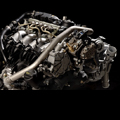
Xantia V6 broken exhaust (update: and rough low rpm running)

Tell us your ongoing tales and experiences with your French car here. Post pictures of your car here as well.
User avatar
Mandrake
Posts: 8692
Joined: 10 Apr 2005, 17:23
x 694

Re: Xantia V6 broken exhaust (update: and rough low rpm runn

Unread post by Mandrake »

PS apologies to stevieb - you're quite right, the fuel pressure regulator is in FRONT of the inlet manifold not underneath it as I had insisted, so in theory can be changed without removing all the upper intake manifold.... :) However the wiring harness on the Xantia version of the engine is a bit different in that area than the 406 making it quite a struggle to move the wiring aside enough to lift the rail when the manifold is still there, but it does look doable.

So what I may do is fit my 2.9 bar fuel pressure regulator after work tonight/tomorrow night and get the car up and running, see how it runs and then if/when a replacement 3.5 bar regulator arrives I can hopefully swap it over without major work. He's probably going to want the original 3.5 bar regulator back before sending a replacement, so I need to remove it ASAP anyway so I think I'll just do that.

By the way I don't think I'm going to use Hylomar blue on the intake manifold gasket this time - its made quite a mess of the manifold face which is going to require quite a bit of scraping to tidy up. :( It seems like it couldn't handle the heat and has partially baked on rather than remaining "non setting". There was no trace of blue left, just a few dark coloured burnt/melted smears.
Simon

2016 Nissan Leaf Tekna 30kWh in White

1997 Xantia S1 3.0 V6 Auto Exclusive in Silex Grey
2011 Peugeot Ion Full Electric in Silver
1998 Xantia S2 3.0 V6 Auto Exclusive
1997 Xantia S1 2.0i Auto VSX
1978 CX 2400
1977 G Special 1129cc LHD
lexi
(Donor 2020)
Posts: 2803
Joined: 17 Apr 2008, 17:51
x 134

Re: Xantia V6 broken exhaust (update: and rough low rpm runn

Unread post by lexi »

Having used it all over Land Rovers for hundreds of years.........it is a gasket material of limited ability..........very ltd.
Citroen C5 1.6 HDI 110bhp Estate 06 plate

French Mistresses gone.
Citroen C5 HDI Mk 1 hatchback
Vel Satis 3.5 v6
ZX 1.9D Est.
ZX 1.9DHatch
Xantia 1.9td est.
Xantia 2.0 hdi Est.
Xantia V6 MK1
Xantia V6 MK 2
User avatar
Mandrake
Posts: 8692
Joined: 10 Apr 2005, 17:23
x 694

Re: Xantia V6 broken exhaust (update: and rough low rpm runn

Unread post by Mandrake »

lexi wrote:Having used it all over Land Rovers for hundreds of years.........it is a gasket material of limited ability..........very ltd.
So you would recommend not using it this time ? Just clean up the surfaces and fit a new gasket dry, as is ? That's what I'm probably going to do.

I tried the extra sealant because I thought I may be chasing a vacuum leak but it didn't make any difference as far as I can tell. (No change in the idle valve opening percentage at hot idle, implying no change in inlet air flow or vacuum leaks at the manifold)
Simon

2016 Nissan Leaf Tekna 30kWh in White

1997 Xantia S1 3.0 V6 Auto Exclusive in Silex Grey
2011 Peugeot Ion Full Electric in Silver
1998 Xantia S2 3.0 V6 Auto Exclusive
1997 Xantia S1 2.0i Auto VSX
1978 CX 2400
1977 G Special 1129cc LHD
lexi
(Donor 2020)
Posts: 2803
Joined: 17 Apr 2008, 17:51
x 134

Re: Xantia V6 broken exhaust (update: and rough low rpm runn

Unread post by lexi »

Just the gasket I would say, nicely torqued. You now know that as manifold was sealed with goo, it made no difference.
I put a new Plenum gasket on Vel, just as is.
There is some better weather after today for tinkering.
Citroen C5 1.6 HDI 110bhp Estate 06 plate

French Mistresses gone.
Citroen C5 HDI Mk 1 hatchback
Vel Satis 3.5 v6
ZX 1.9D Est.
ZX 1.9DHatch
Xantia 1.9td est.
Xantia 2.0 hdi Est.
Xantia V6 MK1
Xantia V6 MK 2
User avatar
Mandrake
Posts: 8692
Joined: 10 Apr 2005, 17:23
x 694

Re: Xantia V6 broken exhaust (update: and rough low rpm runn

Unread post by Mandrake »

That reminds me, I really need to find the torque figures and torquing order for the (upper) manifold bolts.

I've never bothered to torque them to a specific torque or in a specific order before - I've just done them by feel, but now that I have a 1/2" to 3/8" drive adaptor I can use my torque wrench on them. :lol:

I wonder how important the torque and order is when its just a cardboard gasket ?

Yes I see the weather for tomorrow is to be good, so if not tonight I should be able to get a bit done tomorrow night. :)
Simon

2016 Nissan Leaf Tekna 30kWh in White

1997 Xantia S1 3.0 V6 Auto Exclusive in Silex Grey
2011 Peugeot Ion Full Electric in Silver
1998 Xantia S2 3.0 V6 Auto Exclusive
1997 Xantia S1 2.0i Auto VSX
1978 CX 2400
1977 G Special 1129cc LHD
User avatar
Mandrake
Posts: 8692
Joined: 10 Apr 2005, 17:23
x 694

Re: Xantia V6 broken exhaust (update: and rough low rpm runn

Unread post by Mandrake »

Some progress tonight - I removed the suspect 3.5 bar regulator that seems to have a bypass leak and fitted my "2.9" bar regulator (not the one that was on the car with the S/H injectors which measured 2.8 bars, but the one before that) and re-tested the pressure.

Exactly 3.0 bars this time with the pump on, (strange as I'm sure I measured this regulator at 2.9 last time...) and dropping to 2.6 bars but then holding steady with the pump off. In fact after 10 minutes with the pump off the static pressure was still holding at 2.5 bars which is very good, so that seems to be case closed as far as confirming that the 3.5 bar regulator was indeed leaking. :(

I didn't go any further than swapping the regulators, bolting the rail back down and testing the pressure tonight as I didn't want to be working into the dusk and I still haven't heard back about getting a replacement regulator sent or whether I'll just end up sending it back for a refund, especially given that the one that's in there now is measuring bang on 3.0 bars.

An observation I made when swapping the regulators was that the one that I've put back in which is not leaking was much harder to push into the holder or turn once pushed in, even though I greased both o-rings, also the large o-ring on the 3.5 bar regulator which has only been on the car since yesterday seems to have swollen up and gone floppy to the point that you can put a small screwdriver between the o-ring and the body of the regulator without stretching it. :shock:

In fact both o-rings feel kinda "soft" to me compared to those on the original regulator. So even though the small o-ring is the right diameter is it possible its the wrong material (too "soft" and/or not petrol resistant) thus causing a leak past the o-ring ? I tried attaching a hose to the outlet port of the regulator and blowing through it and I couldn't detect any leakage, so I'm wondering whether the leak is indeed past a too-soft o-ring ? :?

Anyone have any experience with o-rings like these leaking due to being the wrong material ? If they are the wrong grade of rubber it doesn't bode well for a replacement being any better - maybe this regulator is just "too cheap" at £30...

I do have two spare OEM regulators one of which - my original one, is too low in pressure to be useful (2.7 bars) I wonder if its worth trying to swap the o-rings off that regulator onto the 3.5 bar one and see if it still leaks with firmer o-rings ??
Simon

2016 Nissan Leaf Tekna 30kWh in White

1997 Xantia S1 3.0 V6 Auto Exclusive in Silex Grey
2011 Peugeot Ion Full Electric in Silver
1998 Xantia S2 3.0 V6 Auto Exclusive
1997 Xantia S1 2.0i Auto VSX
1978 CX 2400
1977 G Special 1129cc LHD
User avatar
Mandrake
Posts: 8692
Joined: 10 Apr 2005, 17:23
x 694

Re: Xantia V6 broken exhaust (update: and rough low rpm runn

Unread post by Mandrake »

Well I've swapped the o-rings over from a spare regulator. With the o-rings off I can tell by trying to pinch them that the ones that came with the 3.5 bar regulator are at least twice as soft as the originals maybe more, also while the outer diameter is about right the inside diameter of both o-rings is too large so they are both a sloppy fit on their respective shafts.

On the small o-ring in particular because the o-ring is loose on the shaft in the recess it fits in I can easily squeeze the tips of the o-ring down with my fingers so that it is smaller in diameter than the main shaft, so with high pressure there is no way this will seal.

With the old o-ring fitted to the new regulator the o-ring is a very snug fit on the recess and I cannot pinch the outside of the o-ring down smaller than the outer shaft with my finger tips so there is at least a chance it will seal. The large o-ring is also a snug fit in its location whereas the other one was loose and floppy.

Could it just be poor quality poor fitting o-rings ? We'll find out tomorrow when I try fitting it back in...stay tuned ;)
Simon

2016 Nissan Leaf Tekna 30kWh in White

1997 Xantia S1 3.0 V6 Auto Exclusive in Silex Grey
2011 Peugeot Ion Full Electric in Silver
1998 Xantia S2 3.0 V6 Auto Exclusive
1997 Xantia S1 2.0i Auto VSX
1978 CX 2400
1977 G Special 1129cc LHD
User avatar
Mandrake
Posts: 8692
Joined: 10 Apr 2005, 17:23
x 694

Re: Xantia V6 broken exhaust (update: and rough low rpm runn

Unread post by Mandrake »

The plot thickens.... ;)

Swapping the o-rings over onto the 3.5 bar regulator made no difference at all - still too low in pressure and still leaking. Here's a couple of videos comparing the pressure tests of the two regulators. The engine is stopped but the Lexia is cycling the fuel pump on and off a few times.

Leaking 3.5 bar regulator:

" onclick="window.open(this.href);return false;


Not only is the pressure only peaking at 2.6 bars, see how quickly it falls to nothing at the end once the pump stays off. This should not happen.

Original regulator:

" onclick="window.open(this.href);return false;


This is peaking at 2.9 bars, and when the pump is turned off it drops to about 2.5 bars and holds steady. In fact when I tested it the night before and came back the next morning (I'd left the gauge connected) it was still reading about 1 bar after 8 hours...

So clearly the 3.5 bar regulator is not working properly - I've contacted the guy and he's happy to replace it or refund it so in the meantime I thought I better get the car back on the road so I put my best 3 bar regulator in, put everything back together including reconnecting the IAT and went for a 15 minute drive.

Disappointment!! :( #-o A slight improvement on before but still not fixed and still running very lean in open loop mode according to my scope! So I was right that a 3% difference in cleaning the injectors wasn't enough, on its own, to explain or cure the lean running. At this point I'm completely at a loss to explain why its still running lean when everything has been tested or ruled out so thoroughly... :roll:

So I put my 6.8K resistor back on in place of the IAT (reading -2 degrees intake temperature on the lexia) and went for a second 15 minute drive and the difference in performance was phenomenal. Back to spinning the wheels from stationary with tons of get up and go compared to feeling heavy and lethargic. I didn't even reset the ECU, just connected the resistor and drove away.

In fact with the clean injectors, slightly higher pressure regulator (2.9 instead of 2.8) the performance WITH the resistor is actually quite noticeably better still than it was with the other injectors/regulator WITH the same resistor. The engine is quieter and smoother when revved under hard acceleration - it doesn't sound as raspy/rough as before which could be due to better power balance between the cylinders.

So how much increase in mixture richness is my resistor providing ? Because its a fixed value it depends on the ambient temperature in the inlet - the hotter the inlet air gets the richer it will run. To find out I plugged the sensor back in and found the air temperature reading on the Lexia after both test drives was about 30 degrees. That's an ambient temperature of about 14 degrees plus some heat soak in the engine bay. The resistor makes it think its -2 degrees therefore:

(273+30)/(273-2) = 1.118 or an 11.8% richer mixture - quite a bit more than I had previously thought as I had forgot to factor in the warming up of the intake air due to engine bay heat soak when I last calculated it based on 17 degrees.

So it seems that an 11.8% richer mixture takes us from really poor performance with lean running under WOT and enough knocking to retard the timing to absolutely flying along with no symptoms at all except a slight hesitation off idle.

But is 11.8% overkill and actually too rich ? How do I find out ?

If I fit a 3.5 bar regulator the mixture richness will only increase by sqrt(3.5/2.9)=1.0985 eg 9.9% roughly, possibly not quite enough. A 3.8 bar regulator would increase it by sqrt(3.8/2.9)=1.145 eg 14.5%, which could be too much, as well as placing a lot more strain on the fuel pump.

So my plan is to temporarily cut into the ground wire to the IAT so I can insert a 6.8K potentiometer sitting on the dash in series with the IAT (instead of replacing it completely) so that I can add between zero and 6.8K of extra resistance even while driving.

Turn it right down to zero and the IAT reports the correct temperature as if unmodified. Turn it up and the IAT reading will go down and cause the open loop mixture to get progressively richer. Because its in series with the IAT rather than replacing it there will still be SOME temperature compensation instead of none at all. That means that the extra mixture richness I "dial in" by adjusting the potentiometer will be somewhat constant with changes in ambient temperature - eg when the air gets hotter and less dense it will back off the injection time to keep the mixture roughly the same.

It won't track perfectly but it will be a lot more constant than it is now with a fixed resistor where its making the mixture much richer when hot but barely at all when cold.

So by adjusting the potentiometer sitting on the dash I can "tune" the mixture in open loop mode in real time. :twisted: It should then be a simple matter to find just how far I have to turn it up until all the drive-ability symptoms and the lean running indicated by the oxygen sensor go away...

Once I find the point where its running properly (plus a small safety margin) how do I find out what percentage mixture increase that is ? Easy - take a note of the IAT temperature reading on the Lexia under those driving conditions to see what temperature it is being fooled into seeing, then turn the potentiometer back to zero for a moment to let the Lexia see the "real" temperature of the intake air, once you know those two figures the ratio is: (273+real temperature)/(273+fake temperature)

Mad scientist ? Yes, that's me.... :lol:
Simon

2016 Nissan Leaf Tekna 30kWh in White

1997 Xantia S1 3.0 V6 Auto Exclusive in Silex Grey
2011 Peugeot Ion Full Electric in Silver
1998 Xantia S2 3.0 V6 Auto Exclusive
1997 Xantia S1 2.0i Auto VSX
1978 CX 2400
1977 G Special 1129cc LHD
User avatar
Mandrake
Posts: 8692
Joined: 10 Apr 2005, 17:23
x 694

Re: Xantia V6 broken exhaust (update: and rough low rpm runn

Unread post by Mandrake »

Hi Chaps,

I need your help. :)

I connected my variable resistor and while it does allow me to adjust the open loop mixture until it's no longer running lean at WOT, the results are a bit disappointing. Yes it makes a big improvement over no resistor at all, but at least yesterday it still doesn't feel right - intermittently sluggish and unwilling at low rpm, which is odd when it seemed so good a few days ago with a resistor. It's definitely performing worse than it should be despite the now rich mixture.

Because I can't find any explanation of why its trying to run so lean at low rpm (it's 10-12% off despite not being able to find any fault in the fuel injection system) and it's still not consistently running right even with the richer mixture I've decided to turn my attention towards the possibility of a mechanical fault with the engine as the underlying cause.

Is there any kind of mechanical fault that could:

1) Cause the open loop mixture to be lean even when the injection system (fuel delivery system, ECU, sensors) is working perfectly ?

2) Could affect low rpm but not high rpm ? (It only runs lean at low rpm below approx 2500 rpm)

3) Which could have occurred suddenly rather than over a period of time ? (It was less than a month between perfect running and flying through the emissions test until the onset of severe lack of low rpm power)

4) Explain some of the other symptoms I've seen, including stumble/hesitation snapping the throttle at idle even with the richer mixture, seemingly low vacuum at idle (only 15" Hg)

I think the answer to all those questions is YES! (can anyone see where I'm going already ?)

On a speed density system like this a key factor in calculating the correct fuel delivery in open loop mode is the volumetric efficiency table. Volumetric efficiency is a measure of how much air the engine can pass through at WOT at every different rpm, measured in grams per second.

This is measured at the factory during the design of the engine and programmed in the ECU as a lookup table, and it is assumed by the ECU that the engine meets these specs. If it does not the mixture will be too lean or too rich in open loop mode, and the ECU cannot compensate in open loop mode.

So what would affect the ability of the engine to "breathe" and thus affect the volumetric efficiency ? Exhaust and intake systems are obvious - if either are restricted it will go down, if they were unusually free flowing it would increase above the normal factory figure.

The problem is to get a lean mixture the flow rate would have to increase above normal, eg a high flow exhaust or intake. A blocked exhaust or intake would actually cause it to run too rich, not too lean.

Now its possible my cheap £75 exhaust may be a bit lacking in baffling and have slightly more flow than an OEM one, but I don't recall noticing any change at all when Richard and I swapped the exhaust over, and also why would it only affect low rpm. (It doesn't run lean at high rpm) The intake system is completely standard - and the air filter is a standard type too, not a "high flow" filter. There are also no vacuum leaks, so it can't be that.

What else affects volumetric efficiency of an engine that we've overlooked ? The valve timing! #-o What if the timing belt jumped a tooth nearly a year and a half ago when the problems began ? :shock:

I've been doing a bit of reading on valve timing and the symptoms of being off by a tooth and its interesting reading. Some engines won't even run if its one tooth off (or will bend a valve) but many will run with symptoms ranging from minor performance issues to major ones.

Remember the ES9J4 is mechanically almost identical to the ES9J4S which added variable valve timing (exhaust only though ?) so there is at least the potential that this engine could run without bending a valve if the timing was off by one tooth.

The various sources I've read say that retarded valve timing would cause a big loss of power at low rpm but have little effect or even increase the power slightly at high rpm, while advanced valve timing does the opposite - a big loss of power at high rpm but little change or an increase in power at low rpm.

Hence the reason for variable valve timing systems - the valve timing is retarded above a certain rpm, typically about 2500-3000 rpm to optimise performance at both low and high rpm. On these variable timing systems the actuator getting stuck in one position or the other can cause a big loss in performance at the high or low end depending on whether its stuck in the advanced or retarded position.

One signature symptom all along with this engine has been that nearly all the power loss has been at low rpm - and the majority of the time (except when I had ignition problems) there has been no loss of power at all above 4000 rpm. This fits in with the possibility of the valve timing being retarded. Valve timing must affect performance by changing the volumetric efficiency, and if it changes differently at different rpm, that could explain how it could be running lean at low rpm but not high rpm, a point that is fundamentally unexplained by any of my previous hypothesis.

A jumped tooth would certainly explain how it could happen so quickly between the MOT and the poor running a few weeks later, and the stubborn resistance to being solved no matter what else I tried. Because a jumped tooth would be a very rare occurrence it could explain why no other V6 owners on the forum seem to have experienced the same problem before, and unless you specifically went looking to verify the timing by pinning the pulleys the fault would remain completely invisible and undetected.

If the crank sprocket jumped a tooth ALL the camshafts would be retarded by a tooth - this seems the most likely possibility as there is no difference in compressions between the different cylinders, and the idle vacuum whilst slightly low is steady. I'm not sure what the symptoms might be if one of the cam sprockets jumped a tooth leaving only one camshaft retarded.

So here's where I need a bit of help:

1) Can someone with the same engine please measure the inlet manifold vacuum at a fully warmed up idle, with no accessory load ? Eg 650 rpm. Mine only produces 15" Hg at idle but it quickly rises to 17" just above idle. I've always felt this is a bit lower than it should be, (at least 17" at idle is normally quoted for most engines) despite the fact that the compressions are all normal and that the exhaust is not blocked. Apparently low manifold vacuum at idle with no other cause found is one of the symptoms of a valve timing problem.

2) Can someone tell me the number, length and diameter of the pegs for pinning the timing pulleys, and also how much disassembly is needed to peg the pulleys to verify the timing ? Do I need to remove the aux belt and aux belt crank pulley before I can pin the timing ?

If there is even the slightest chance that the timing has jumped a tooth I need to find out ASAP - not just to prevent me wasting more time chasing other blind alleys but because if it has really been running with a jumped timing belt for over a year I'm literally running on borrowed time and need to get the timing belt done ASAP! :shock:

At the very least it would be nice to rule it out as a possibility, and fairly quickly.

Simon

2016 Nissan Leaf Tekna 30kWh in White

1997 Xantia S1 3.0 V6 Auto Exclusive in Silex Grey
2011 Peugeot Ion Full Electric in Silver
1998 Xantia S2 3.0 V6 Auto Exclusive
1997 Xantia S1 2.0i Auto VSX
1978 CX 2400
1977 G Special 1129cc LHD
User avatar
DHallworth
(Donor 2025)
Posts: 2431
Joined: 20 Nov 2005, 17:05
x 163

Re: Xantia V6 broken exhaust (update: and rough low rpm runn

Unread post by DHallworth »

Simon,

Not sure on the answer to your other questions but the timing belt bits are as below:

To set the timing I used an M8 bolt with the thread ground off it. I did the XM and the C5 that way but have now got the official Citroen timing belt kit to do it.

You need to remove a fair bit to do it as you need to take all the timing covers off. If you're going that far you'd be as well doing the belt.

You need to take the aux belt, crank shaft pulley and hydraulic pump pulley off. Once you've done that you need to put a jack under the engine and take the weight as you need to take the engine mount off. Then you take the auxiliary belt tensioner off. Once you've got this lot off, you then take all of the bolts off the cam covers. They loosen but don't come all the way out. One of them down the back is quite awkward.

You'll need to undo the wiring loom bolt to the top of the engine mount and then unplug the ECU's and move the wiring out of the way too.

I've got two engines down here that are out of the car at the moment if you want a look at them.

Regards

David.
'98 Xantia Activa V6 :-D
'00 XM V6 Exclusive
'09 C5 2.7 HDi Exclusive
‘10 C5 3.0 HDi Exclusive
'12 C6 3.0 HDi Exclusive
'15 C4 BlueHDi Feel
User avatar
Mandrake
Posts: 8692
Joined: 10 Apr 2005, 17:23
x 694

Re: Xantia V6 broken exhaust (update: and rough low rpm runn

Unread post by Mandrake »

Hi David,

That's not what I was hoping to hear, as you can probably imagine. :(

Not having done a cam belt on this particular engine before (a 2 litre 8 valve Xantia doesn't really compare!) here is what I imagined it would be to just check the timing:

1) Remove aux belt - not sure why the hydraulic pump pulley would need to come off but if it does its not too difficult - I've had the belt and hydraulic pump out before.

2) Remove aux belt crank pulley. (I'm assuming that needs a nice long breaker bar and some way to lock the engine, and loctite on refitting ?

3) Remove timing covers.

4) Turn the engine over with the breaker bar to get the timing holes lined up then attempt to insert all the locking pegs. If they don't all go in at once due to a jumped tooth, put a white mark between pulley and block on the ones that do peg up together then remove the pegs and turn the engine until the remaining pulley(s) can be pegged then compare the marks to see how far out they are.

If I remember right from your photos there is one locking peg through each cam pulley into the block, and one through the crank hub to the block ? EG the timing is done entirely with locking pegs rather than visual alignment of marks between pulleys and the block like some engines ?

You talk about removing the aux belt tensioner, engine mount, and jacking up the engine - are you sure those aren't only necessary if you're actually removing the belt, rather than checking to see if the pegs go in ? I would have thought access to insert the upper pegs in the cam wheels would be fairly good, and the crank hub should be accessible through the wheel arch with the liner removed ?

I know in a perfect world I'd just do the belt anyway at the same time as its probably long overdue and it is of unknown condition, but the problem is with a more than a year history of a so far unsolvable problem which could potentially never be solved, if I just go ahead and replace the belt, water pump, tensioner (for the new type) rollers etc (it does need rollers from the noise it makes) without knowing whether the timing is out and therefore related to the problem then that's a LOT of money for me spend on a car that I may end up having to get rid of if the problem is unsolvable and causes it to fail its mot with no solution in sight. (That's precisely why I haven't already done the belt - if I wasn't having all these problems and the car was running ok it would have been done by now)

I also can't afford to spend that amount of money on it when I have so much else to do to it before the MOT IF it doesn't also solve the issue at hand. SWMBO would crucify me if I spent all that money on doing the belt, and it didn't do anything for the symptoms, it didn't pass the MOT and I ended up having to ditch it. :( I have a limited amount of money to spend on it pre MOT so I have to choose wisely.

So even though its quite a bit of duplication of work, from a money perspective and troubleshooting perspective an exploratory session to strip it down to the point where I can check and measure the timing by trying to pin it makes a lot of sense. If the timing is ok and the belt is reasonable then I'm afraid the reality is the belt must wait until after it passes the MOT so that I can spend money on finding and fixing whatever the problem is, and not waste additional money on a car that might never pass the MOT and have to been given up on.

On the other hand if checking the timing discovers that it has in fact jumped a tooth, or that the belt has stretched a lot (which apparently can retard the valve timing a few degrees) and/or the tensioner/rollers are faulty causing the belt to be loose and perhaps cause intermittent variations in valve timing then I will replace the belt (and pump, tensioner, rollers etc) post haste!

If the timing is indeed out a tooth I have a pretty strong case that not only is the belt urgent for the safety of the engine, but it has a very good chance of solving the underlying low rpm performance issue I've been searching for for so long. I need to be really certain of the diagnosis before spending that money, even if I end up doing the first half the job twice. My time is free, up to a point, my money is scarce.. :lol:
Simon

2016 Nissan Leaf Tekna 30kWh in White

1997 Xantia S1 3.0 V6 Auto Exclusive in Silex Grey
2011 Peugeot Ion Full Electric in Silver
1998 Xantia S2 3.0 V6 Auto Exclusive
1997 Xantia S1 2.0i Auto VSX
1978 CX 2400
1977 G Special 1129cc LHD
User avatar
DHallworth
(Donor 2025)
Posts: 2431
Joined: 20 Nov 2005, 17:05
x 163

Re: Xantia V6 broken exhaust (update: and rough low rpm runn

Unread post by DHallworth »

Simon,

The hydraulic pump pulley has to come off so you can get the timing covers off. As does the top engine mount and aux belt tensioner I'm afraid.

The crank pulley is held on by 4 small bolts around the main crank shaft bolt so you don't need much effort to take that off.

The timing on the V6 can't slip a tooth really as the pulleys are adjustable inside the sprocket. If the timing is out you loosen 4 bolts and rotate the inner half of the camshaft pulley until it lines up.

Here's a video of it being done on a 406 Coupe:


It's in French but you can get the general idea from the video.

David.
'98 Xantia Activa V6 :-D
'00 XM V6 Exclusive
'09 C5 2.7 HDi Exclusive
‘10 C5 3.0 HDi Exclusive
'12 C6 3.0 HDi Exclusive
'15 C4 BlueHDi Feel
User avatar
Mandrake
Posts: 8692
Joined: 10 Apr 2005, 17:23
x 694

Re: Xantia V6 broken exhaust (update: and rough low rpm runn

Unread post by Mandrake »

Thanks David - I've seen that video before some time ago but I watched it again to refresh my memory and yes you're right - the pump pulley and engine mount obviously have to come out to free the front timing cover. (But not the back ?)

Bugger! #-o

When you say it can't slip/jump a tooth because of the adjustable cam sprocket design I'm not sure that I agree - if the tensioner or one of the pulleys was faulty, there was oil leaking onto the belt, foreign objects etc it could jump a tooth just like any non adjustable cam sprocket.

However after watching the video and thinking about what you've said, two things have occurred to me. :)

1) If it had jumped a tooth, so long as the cam wheels were originally adjusted near the middle of their adjustment slots, as you say it should be possible to correct the timing without removing the belt or messing with the belt tension by loosening the cam wheel bolts and turning the camshafts (with that tool) until they peg properly then re-tightening the bolts ?

That would make a temporary correction of the timing (until a new belt kit can be installed) quite feasible, as long as I had access to the pegs and the sprocket adjustment tool.

2) I've just had a sudden realisation of another possible cause of the valve timing being out WITHOUT the belt actually jumping a tooth. What if the cam sprocket bolts have been under-torqued when the belt was last changed, and they've worked loose enough to allow the cam sprocket adjustment to slip when subject to enough torque, for example abrupt acceleration and deceleration events ? (Or rough gear changes due to a cranky gearbox, which has certainly happened plenty of times)

That could easily explain the intermittent nature of the problem - as everyone reading this thread knows, over the last year some days it would run like a charm, some days it would be terrible, sometimes different driving sessions on the same day were even very different.

What if the kick back when the engine was stopped was enough to kick the alignment of a sprocket one way, and abrupt acceleration at high rpm enough to kick it the other way - thus the valve timing on one or more cams was semi-randomly changing each time the car was driven ?

The adjustment slot looks like it could give one tooth maybe two teeth of movement in each direction - enough to cause a massive change in performance, but probably not enough to cause valve to piston contact.

Varying the inlet cams would have the most effect on low down torque, and if only ONE of the inlet cams was slipping position then when the two banks were timed differently the engine would run quite rough as the power balance between the banks would be poor, more so at low rpm.

The more I think about the symptoms, the more I believe it is valve timing related, and that the valve timing error could possibly be varying semi-randomly. Far fetched, or something that definitely needs checking ? :)
Last edited by Mandrake on 18 May 2014, 22:51, edited 1 time in total.
Simon

2016 Nissan Leaf Tekna 30kWh in White

1997 Xantia S1 3.0 V6 Auto Exclusive in Silex Grey
2011 Peugeot Ion Full Electric in Silver
1998 Xantia S2 3.0 V6 Auto Exclusive
1997 Xantia S1 2.0i Auto VSX
1978 CX 2400
1977 G Special 1129cc LHD
Northern_Mike

Re: Xantia V6 broken exhaust (update: and rough low rpm runn

Unread post by Northern_Mike »

I would say, politely, that I don't believe it would be this. In my experience of timing belts and chains, I can't see how it would skip back and forth to adjust itself so sometime it ran really well, and sometimes not. I can see how a belt could *possibly* jump a tooth if it were totally and utterly knackered and the tensioners were screwed, but it didn't even do that on my Punto, which had a belt in the worst condition I'd ever seen, nor did the chain jump on my Lada 1200 when the tensioner had completely fallen apart and the chain was so loose it chewed into the side of the head :shock:

Obviously, this is a different engine, but I'd still say, that if the belt or pulleys are loose enough to move, by now they'd have moved enough to ruin something in a manner you would not really care for much.
User avatar
Mandrake
Posts: 8692
Joined: 10 Apr 2005, 17:23
x 694

Re: Xantia V6 broken exhaust (update: and rough low rpm runn

Unread post by Mandrake »

Yes, I agree if the belt jumped it would not jump back and forth, I wasn't suggesting that... but look at the design of the adjustable cam sprocket - if those four small bolts are loose there is nothing to stop the timing of that cam varying plus or minus a tooth or so without the belt having to jump. The adjustment range of the slot limits the maximum that the timing of that cam would slip to a probably "safe" range.

I've never had a cam belt slip or jump a tooth on me before either Mike, but this car is not exactly "normal" in its problems is it... ;) When so many other possibilities have been carefully ruled out we have to look towards the less likely but still feasible possibilities. Science says there must be an explanation for the problem.
Last edited by Mandrake on 18 May 2014, 23:02, edited 1 time in total.
Simon

2016 Nissan Leaf Tekna 30kWh in White

1997 Xantia S1 3.0 V6 Auto Exclusive in Silex Grey
2011 Peugeot Ion Full Electric in Silver
1998 Xantia S2 3.0 V6 Auto Exclusive
1997 Xantia S1 2.0i Auto VSX
1978 CX 2400
1977 G Special 1129cc LHD