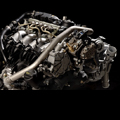
Hi Chaps,
I need your help.

I connected my variable resistor and while it does allow me to adjust the open loop mixture until it's no longer running lean at WOT, the results are a bit disappointing. Yes it makes a big improvement over no resistor at all, but at least yesterday it still doesn't feel right - intermittently sluggish and unwilling at low rpm, which is odd when it seemed so good a few days ago with a resistor. It's definitely performing worse than it should be despite the now rich mixture.
Because I can't find any explanation of why its trying to run so lean at low rpm (it's 10-12% off despite not being able to find any fault in the fuel injection system) and it's still not consistently running right even with the richer mixture I've decided to turn my attention towards the possibility of a mechanical fault with the engine as the underlying cause.
Is there any kind of mechanical fault that could:
1) Cause the open loop mixture to be lean even when the injection system (fuel delivery system, ECU, sensors) is working perfectly ?
2) Could affect low rpm but not high rpm ? (It only runs lean at low rpm below approx 2500 rpm)
3) Which could have occurred suddenly rather than over a period of time ? (It was less than a month between perfect running and flying through the emissions test until the onset of severe lack of low rpm power)
4) Explain some of the other symptoms I've seen, including stumble/hesitation snapping the throttle at idle even with the richer mixture, seemingly low vacuum at idle (only 15" Hg)
I think the answer to all those questions is YES! (can anyone see where I'm going already ?)
On a speed density system like this a key factor in calculating the correct fuel delivery in open loop mode is the volumetric efficiency table. Volumetric efficiency is a measure of how much air the engine can pass through at WOT at every different rpm, measured in grams per second.
This is measured at the factory during the design of the engine and programmed in the ECU as a lookup table, and it is
assumed by the ECU that the engine meets these specs. If it does not the mixture will be too lean or too rich in open loop mode, and the ECU cannot compensate in open loop mode.
So what would affect the ability of the engine to "breathe" and thus affect the volumetric efficiency ? Exhaust and intake systems are obvious - if either are restricted it will go down, if they were unusually free flowing it would increase above the normal factory figure.
The problem is to get a lean mixture the flow rate would have to
increase above normal, eg a high flow exhaust or intake. A blocked exhaust or intake would actually cause it to run too rich, not too lean.
Now its possible my cheap £75 exhaust may be a bit lacking in baffling and have slightly more flow than an OEM one, but I don't recall noticing any change at all when Richard and I swapped the exhaust over, and also why would it only affect low rpm. (It doesn't run lean at high rpm) The intake system is completely standard - and the air filter is a standard type too, not a "high flow" filter. There are also no vacuum leaks, so it can't be that.
What else affects volumetric efficiency of an engine that we've overlooked ? The valve timing!

What if the timing belt jumped a tooth nearly a year and a half ago when the problems began ?

I've been doing a bit of reading on valve timing and the symptoms of being off by a tooth and its interesting reading. Some engines won't even run if its one tooth off (or will bend a valve) but many will run with symptoms ranging from minor performance issues to major ones.
Remember the ES9J4 is mechanically almost identical to the ES9J4S which added variable valve timing (exhaust only though ?) so there is at least the potential that this engine could run without bending a valve if the timing was off by one tooth.
The various sources I've read say that retarded valve timing would cause a big loss of power at low rpm but have little effect or even increase the power slightly at high rpm, while advanced valve timing does the opposite - a big loss of power at high rpm but little change or an increase in power at low rpm.
Hence the reason for variable valve timing systems - the valve timing is retarded above a certain rpm, typically about 2500-3000 rpm to optimise performance at both low and high rpm. On these variable timing systems the actuator getting stuck in one position or the other can cause a big loss in performance at the high or low end depending on whether its stuck in the advanced or retarded position.
One signature symptom all along with this engine has been that nearly all the power loss has been at low rpm - and the majority of the time (except when I had ignition problems) there has been no loss of power at all above 4000 rpm. This fits in with the possibility of the valve timing being retarded. Valve timing must affect performance by changing the volumetric efficiency, and if it changes differently at different rpm, that could explain how it could be running lean at low rpm but not high rpm, a point that is fundamentally unexplained by any of my previous hypothesis.
A jumped tooth would certainly explain how it could happen so quickly between the MOT and the poor running a few weeks later, and the stubborn resistance to being solved no matter what else I tried. Because a jumped tooth would be a very rare occurrence it could explain why no other V6 owners on the forum seem to have experienced the same problem before, and unless you specifically went looking to verify the timing by pinning the pulleys the fault would remain completely invisible and undetected.
If the crank sprocket jumped a tooth ALL the camshafts would be retarded by a tooth - this seems the most likely possibility as there is no difference in compressions between the different cylinders, and the idle vacuum whilst slightly low is steady. I'm not sure what the symptoms might be if one of the cam sprockets jumped a tooth leaving only one camshaft retarded.
So here's where I need a bit of help:
1) Can someone with the same engine please measure the inlet manifold vacuum at a fully warmed up idle, with no accessory load ? Eg 650 rpm. Mine only produces 15" Hg at idle but it quickly rises to 17" just above idle. I've always felt this is a bit lower than it should be, (at least 17" at idle is normally quoted for most engines) despite the fact that the compressions are all normal and that the exhaust is not blocked. Apparently low manifold vacuum at idle with no other cause found is one of the symptoms of a valve timing problem.
2) Can someone tell me the number, length and diameter of the pegs for pinning the timing pulleys, and also how much disassembly is needed to peg the pulleys to verify the timing ? Do I need to remove the aux belt and aux belt crank pulley before I can pin the timing ?
If there is even the slightest chance that the timing has jumped a tooth I need to find out ASAP - not just to prevent me wasting more time chasing other blind alleys but because if it has really been running with a jumped timing belt for over a year I'm literally running on borrowed time and need to get the timing belt done ASAP!
At the very least it would be nice to rule it out as a possibility, and fairly quickly.


 It seems like it couldn't handle the heat and has partially baked on rather than remaining "non setting". There was no trace of blue left, just a few dark coloured burnt/melted smears.


 It should then be a simple matter to find just how far I have to turn it up until all the drive-ability symptoms and the lean running indicated by the oxygen sensor go away...