xantos wrote:
It works on pressure equalization principle. You pump the hydraulic jack until you see that the pressure on the gauge doesn't rise anymore. Then you know how much pressure is left in the sphere. Quite simple really...
Actually that's not how you would test it. You pump it up until the oil pressure is higher than the expected rest gas pressure of the sphere, (for example on a 50 bar sphere pump it up to 60 bars or so) then very slowly release the pressure.
As you release pressure the reading will slowly and smoothly drop until it reaches the gas pressure of the sphere, at that point it will instantly drop to zero. So if the pressure very slowly falls from 60 to 50 bars and then suddenly drops to zero, 50 bars is the gas pressure of the sphere.
When the oil pressure is greater than the rest gas pressure the gas is compressed (to the same pressure as the oil of course) and the diaphragm moves in. When you bleed the pressure out again as soon as the diaphragm touches the bottom and can no longer move pressure drops to zero almost instantly.
Anyone has blueprints for regassing tool?

I remember helping my Dad build one but it was over 10 years ago and I can't remember the details very well.

You have to find some way to create an air tight high pressure pocket above the filler valve and unscrew and then screw up the filler valve in the process.
From memory it was a big steel clamp that clamped around the top and bottom of the sphere - the top had an o-ring a little bit larger than the diameter of the filler cap that pressed onto the sphere body and sat in a groove in the clamp body to get a pressure tight seal against the body of the sphere - there was a small crank with a peg to turn the filler plug (which had to have a small hole drilled in the top for the peg to fit into) and the crank shaft was sealed with an o-ring as well. As you're dealing with high gas pressures getting a seal is very difficult. You need an adjustable pressure regulator valve on your gas bottle to control the flow of gas and pressure to a safe level too - one that has an adjustment range that encompass the pressures of the spheres you want to fill.
The idea being that you fill it slowly but as it reaches the desired pressure you leave the gas valve open but with the pressure regulator regulating the exact desired pressure, then close the filler plug on the sphere while that pressure is regulated, and only then turn off the regulator on the gas bottle. Thus you end up with exactly the right pressure in the sphere. If you turn off the gas supply before closing the filler plug the small amount of leakage past the o-rings will cause you to end up with a lower than desired pressure in the sphere.
It worked, but it wasn't the best sphere re-gassing tool ever...

The main difficulty is getting a gas tight seal against the sphere at such high pressures, especially if the surface of the sphere is rusty... sanding and repainting a rusty sphere first is probably a good idea.

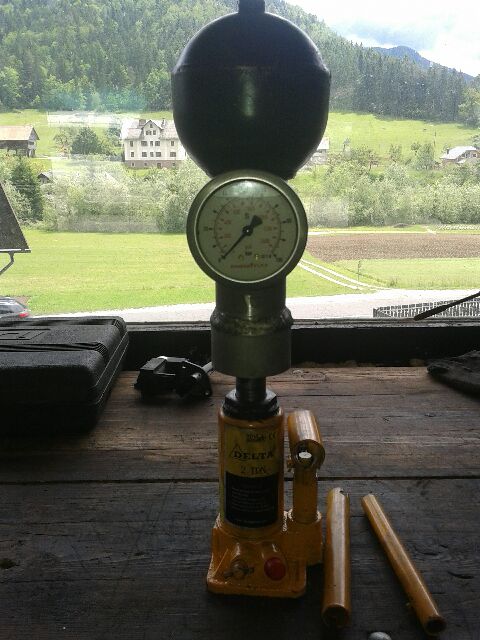

 )
)