
The spheres on the green estate were changed 5 years and 44,000 miles ago. In the last year or so, although the suspension passes all the usual tests, the ride seems to have got noticeably harder the suspension passes all the usual tests. However, that's an entirely subjective impression and, like many other Xantia owners, I don't have the opportunity to compare our estate with another which has new spheres. I'm reluctant to go to the expense of changing the spheres, possibly for comfort ones, when I don't know how bad/good the existing ones are.
As far as I'm aware, the only objective test is to take the spheres off and get the gas pressures tested on a rig - but for most of us it would be simpler and probably cheaper to just fit new ones.
This set me thinking about a simple way to roughly check the gas in 'corner' spheres based on the fact that the amount of gas affects the spring rate - fully charged spheres provide soft springing, long suspension travel and good damping; near-flat spheres give very stiff suspension with a hard bouncy ride.
I came up with this:
Park the car on a reasonably smooth flat and level surface with a quarter-full fuel tank and the boot empty, measure the ride height at each rear wheel arch. Heave two 25L polydrums full of water (50Kg or 110lb) centrally into the back of the boot and quickly measure the ride height again before the suspension responds. Repeat the test, heaving both polydrums into the front footwells (one each side). Side to side, the suspension should sink the same amount - if not, one sphere is worse than the other.
If we knew what the changes in height for a particular load should be for a particular model with known good new spheres, that would be a benchmark for other cars with the same spheres.
I chose 25L polydrums as loads because they are fairly easy to acquire for free and I expect 50Kg to make the suspension sink by a sensible amount. If I get a chance tomorrow, I'll try out our estate.
Does anyone see any flaws in my thinking?
Does anyone know whether Xantia 'springs' are progressive or constant rate?
Volunteers to test their own cars before and after fitting new spheres?
Possible simple sphere test?
-
Old-Guy

- (Donor 2025)
- Posts: 1815
- Joined: 11 Sep 2008, 12:08
- x 24
Possible simple sphere test?
2012 Subaru Forester - capable but no magic carpet
2011 Grand C4 Picasso VTR+ 1.6HDi - not missed!
1995 Xantia Estate SX 1.9TD in Vert Vega "The Green Lady" - sadly missed
1998 Xantia 2.1 VXD Estate in Mauritius Blue - R.I.P. (terminal tin-worm)
2011 Grand C4 Picasso VTR+ 1.6HDi - not missed!
1995 Xantia Estate SX 1.9TD in Vert Vega "The Green Lady" - sadly missed
1998 Xantia 2.1 VXD Estate in Mauritius Blue - R.I.P. (terminal tin-worm)
-
Mandrake

- Posts: 8692
- Joined: 10 Apr 2005, 17:23
- x 694
Re: Possible simple sphere test?
Nice idea, but I see a few problems with your approach.
Problem 1) For trying to compare left and right spheres by placing the load to the left or right of the car you will be thwarted by the roll bar. Yes there would be some difference in displacement if the left and right spheres were unbalanced, however the majority of it would be soaked up by the roll-bar, so the imbalance between left and right spheres would have to be huge (to the point of dangerous driving) before there was an obvious difference.
It's not often recognised, but a Hydropneumatic Citroen has NO inherent resistance to body roll without the roll bar, unlike a conventionally sprung car which has the springing of the coil springs which will resist body roll before a roll bar is even applied. This is because the cross connected suspension allows oil to flow from one side to the other in the case of a pressure imbalance. If the right of the car was carrying more weight than the left, even say 50Kg, that side of the car would sink to the bump stop and the opposite side would rise to the top limit!
For this reason Hydropneumatic Citroen's rely completely on the roll bar for static stability in the roll axis, so the roll bars tend to be fairly stiff. Not only would you be thwarted by one roll bar, you would be thwarted by both roll bars at once. A load placed in the rear left corner of the car will be supported in the roll axis by both the rear and front roll bars...
Problem 2) Placing a fixed load in the car and measuring how far it drops is never going to be accurate because even a modest load of 50Kg or so on the rear suspension is enough to bottom the suspension on the bump stops, thus the distance you measure is going to be much the same for anything over a relatively modest weight. You could do it the other way around however - measure the travel from normal height to suspension bottomed, then find out by trial an error what load caused it to drop by half that amount - that way you know the suspension is not being bottomed and is still within its linear range.
Problem 3) On a hydractive car you have two lots of spheres that provide the total springing rate for each axle - the corner spheres and the hydractive regulator sphere. It's the sum volume of the three spheres that decides your static springing rate which would be reflected by how much load is required to achieve a certain displacement, but you would have no way of distinguishing whether the corner spheres or the hydractive regulator sphere were flat (or both) if the displacement wasn't as expected.
In answer to the spring rate being progressive or constant, it depends on your perspective. From the perspective of loading the car up with a heavy load it is progressive - the spring rate gets proportionately stiffer as you load the car. However from the perspective of how much does the spring rate change with suspension displacement for a given static load, the answer is "very little", meaning that from a bump absorbing perspective the suspension is more or less constant spring rate. (Hydractive hard/soft ignored) The damping is progressive though, single stage threshold in Hydropnematic and dual stage progressive in Hydractive soft mode.
(The leaf valves in the corner spheres of a HA2 model are stiffer than the leaf valves in the hydractive regulator block dampers, thus there are two different damping thresholds, the one for the middle regulator sphere opens sooner and more easily than the strut sphere leaf valves...)
There is a way to measure the gas pressure of spheres without building a dedicated testing rig - its not exactly convenient depending on model of Xantia, but it is very accurate. Use the pressure regulator and an external pressure gauge as your test rig.
To do this test you need a hydraulic pressure gauge with a length of Citroen hydraulic line and union brazed onto it so that you can disconnect the output line of the pressure regulator and plug your pressure gauge in as a dead-end. Other than that no special equipment is needed.
De-pressurize the car fully while up on stands so you can get the spheres off easily, open the bleed screw, connect the gauge in place of the normal output pipe and fit each sphere you want to test in turn onto the pressure regulator. Let the engine run and close the bleed screw until the pressure reaches cut-out. Turn off the engine and open the bleed screw enough so that the pressure drops fairly slowly. When the pressure reaches the gas pressure of the sphere the gauge will suddenly jump to zero. The reading before it jumped to zero is your gas pressure. Easy.
I've used this method a few times when I've absolutely had to know whether a sphere was good or not. Jim has posted pictures before of a pressure gauge being inserted in the pressure regulator output, although I don't recall in which thread.
It's quite easy on a model like a 2.0i petrol that has good access to the pressure regulator and accumulator sphere, not so easy on a model like the V6 where the pressure regulator is back to front and crammed in!
Problem 1) For trying to compare left and right spheres by placing the load to the left or right of the car you will be thwarted by the roll bar. Yes there would be some difference in displacement if the left and right spheres were unbalanced, however the majority of it would be soaked up by the roll-bar, so the imbalance between left and right spheres would have to be huge (to the point of dangerous driving) before there was an obvious difference.
It's not often recognised, but a Hydropneumatic Citroen has NO inherent resistance to body roll without the roll bar, unlike a conventionally sprung car which has the springing of the coil springs which will resist body roll before a roll bar is even applied. This is because the cross connected suspension allows oil to flow from one side to the other in the case of a pressure imbalance. If the right of the car was carrying more weight than the left, even say 50Kg, that side of the car would sink to the bump stop and the opposite side would rise to the top limit!
For this reason Hydropneumatic Citroen's rely completely on the roll bar for static stability in the roll axis, so the roll bars tend to be fairly stiff. Not only would you be thwarted by one roll bar, you would be thwarted by both roll bars at once. A load placed in the rear left corner of the car will be supported in the roll axis by both the rear and front roll bars...
Problem 2) Placing a fixed load in the car and measuring how far it drops is never going to be accurate because even a modest load of 50Kg or so on the rear suspension is enough to bottom the suspension on the bump stops, thus the distance you measure is going to be much the same for anything over a relatively modest weight. You could do it the other way around however - measure the travel from normal height to suspension bottomed, then find out by trial an error what load caused it to drop by half that amount - that way you know the suspension is not being bottomed and is still within its linear range.
Problem 3) On a hydractive car you have two lots of spheres that provide the total springing rate for each axle - the corner spheres and the hydractive regulator sphere. It's the sum volume of the three spheres that decides your static springing rate which would be reflected by how much load is required to achieve a certain displacement, but you would have no way of distinguishing whether the corner spheres or the hydractive regulator sphere were flat (or both) if the displacement wasn't as expected.
In answer to the spring rate being progressive or constant, it depends on your perspective. From the perspective of loading the car up with a heavy load it is progressive - the spring rate gets proportionately stiffer as you load the car. However from the perspective of how much does the spring rate change with suspension displacement for a given static load, the answer is "very little", meaning that from a bump absorbing perspective the suspension is more or less constant spring rate. (Hydractive hard/soft ignored) The damping is progressive though, single stage threshold in Hydropnematic and dual stage progressive in Hydractive soft mode.
(The leaf valves in the corner spheres of a HA2 model are stiffer than the leaf valves in the hydractive regulator block dampers, thus there are two different damping thresholds, the one for the middle regulator sphere opens sooner and more easily than the strut sphere leaf valves...)
There is a way to measure the gas pressure of spheres without building a dedicated testing rig - its not exactly convenient depending on model of Xantia, but it is very accurate. Use the pressure regulator and an external pressure gauge as your test rig.
To do this test you need a hydraulic pressure gauge with a length of Citroen hydraulic line and union brazed onto it so that you can disconnect the output line of the pressure regulator and plug your pressure gauge in as a dead-end. Other than that no special equipment is needed.
De-pressurize the car fully while up on stands so you can get the spheres off easily, open the bleed screw, connect the gauge in place of the normal output pipe and fit each sphere you want to test in turn onto the pressure regulator. Let the engine run and close the bleed screw until the pressure reaches cut-out. Turn off the engine and open the bleed screw enough so that the pressure drops fairly slowly. When the pressure reaches the gas pressure of the sphere the gauge will suddenly jump to zero. The reading before it jumped to zero is your gas pressure. Easy.
I've used this method a few times when I've absolutely had to know whether a sphere was good or not. Jim has posted pictures before of a pressure gauge being inserted in the pressure regulator output, although I don't recall in which thread.
It's quite easy on a model like a 2.0i petrol that has good access to the pressure regulator and accumulator sphere, not so easy on a model like the V6 where the pressure regulator is back to front and crammed in!
Simon
2016 Nissan Leaf Tekna 30kWh in White
1997 Xantia S1 3.0 V6 Auto Exclusive in Silex Grey
2011 Peugeot Ion Full Electric in Silver
1998 Xantia S2 3.0 V6 Auto Exclusive
1997 Xantia S1 2.0i Auto VSX
1978 CX 2400
1977 G Special 1129cc LHD
2016 Nissan Leaf Tekna 30kWh in White
1997 Xantia S1 3.0 V6 Auto Exclusive in Silex Grey
2011 Peugeot Ion Full Electric in Silver
1998 Xantia S2 3.0 V6 Auto Exclusive
1997 Xantia S1 2.0i Auto VSX
1978 CX 2400
1977 G Special 1129cc LHD
-
addo
- Sara Watson's Stalker
- Posts: 7098
- Joined: 19 Aug 2008, 12:38
- x 95
Not sure why pressure testing has to be considered dear.
I'm prototyping a screw-in neck for £20 Ebay Chinese bottle jacks, that would allow quick and simple conversion into a sphere tester; no welding, turning etc required. Likely cost of the adaptor alone would be £70-ish, and you need to source a gauge, but then the knowledge (via a simple piece of kit) is there for life.
I'm prototyping a screw-in neck for £20 Ebay Chinese bottle jacks, that would allow quick and simple conversion into a sphere tester; no welding, turning etc required. Likely cost of the adaptor alone would be £70-ish, and you need to source a gauge, but then the knowledge (via a simple piece of kit) is there for life.
-
Hell Razor5543
- (Donor 2023)
- Posts: 14290
- Joined: 01 Apr 2012, 09:47
- x 3300
Re: Possible simple sphere test?
CitroJim has made an efffective tested using a regulator, gauge, and mount. You have to remove each sphere to test it, but it looked very simple and accurate. Try searching on the Citroen part of the forum.
James
ex BX 1.9
ex Xantia 2.0HDi SX
ex Xantia 2.0HDi LX
ex C5 2.0HDi VTR
ex C5 2.0HDi VTR
ex C5 2.2HDi VTX+
Yes, I am paranoid, but am I paranoid ENOUGH?
Out amongst the stars, looking for a world of my own!
ex BX 1.9
ex Xantia 2.0HDi SX
ex Xantia 2.0HDi LX
ex C5 2.0HDi VTR
ex C5 2.0HDi VTR
ex C5 2.2HDi VTX+
Yes, I am paranoid, but am I paranoid ENOUGH?
Out amongst the stars, looking for a world of my own!
-
Old-Guy
- (Donor 2025)
- Posts: 1815
- Joined: 11 Sep 2008, 12:08
- x 24
Re: Possible simple sphere test?
"Possible SIMPLE sphere test"
My original post proposed "heaving both polydrums into the front footwells (one each side)". I then confused the issue by talking about differences between the sides. Yes, of course both sides will sink evenly - for the reasons stated by Mandrake.
Removing spheres to test them isn't my idea of SIMPLE. I'm not proposing a method of measuring possible loss of gas with any accuracy, but I think a simple, objective and non-invasive test that allows the owner of any 5 or 6 sphere Xantia to simply determine whether the front and/or rear 'corner' spheres (in pairs) are relatively 'bad' would be useful to many of us. Like the 'sit-in' and 'tick' tests.
I should have specified 'bog-standard' suspension - i.e. the majority.
I'm surprised that 50Kg is enough to make the rear suspension of an estate bottom-out - until the height corrector kicks in. But I haven't had time today to experiment.
Spring rate is not a matter of perspective - it's a matter of mechanics (deflection per unit load) and has nothing to do with damping. Loss of gas has an effect on both damping and suspension travel. A smaller mass of gas requires less movement (of suspension and thus volume of LHM) to change its pressure by any given amount - the ultimate being: almost no gas = almost no 'springs'. A significantly reduced flow of LHM between strut/ram and sphere means less damping - so a stiffer, more bouncy, ride. Which is where I originally started from - how stiff and bouncy.
"Dear" as in investing in any sort of test rig (that might be used once every 2-3 years) or travelling to, and compensating, someone who does have a test-rig.
I am aware of Jim's ingenious rig and the alternative using the in-car pump as pressure source.
None the less, my thanks for the contributions to date.
My original post proposed "heaving both polydrums into the front footwells (one each side)". I then confused the issue by talking about differences between the sides. Yes, of course both sides will sink evenly - for the reasons stated by Mandrake.
Removing spheres to test them isn't my idea of SIMPLE. I'm not proposing a method of measuring possible loss of gas with any accuracy, but I think a simple, objective and non-invasive test that allows the owner of any 5 or 6 sphere Xantia to simply determine whether the front and/or rear 'corner' spheres (in pairs) are relatively 'bad' would be useful to many of us. Like the 'sit-in' and 'tick' tests.
I should have specified 'bog-standard' suspension - i.e. the majority.
I'm surprised that 50Kg is enough to make the rear suspension of an estate bottom-out - until the height corrector kicks in. But I haven't had time today to experiment.
Spring rate is not a matter of perspective - it's a matter of mechanics (deflection per unit load) and has nothing to do with damping. Loss of gas has an effect on both damping and suspension travel. A smaller mass of gas requires less movement (of suspension and thus volume of LHM) to change its pressure by any given amount - the ultimate being: almost no gas = almost no 'springs'. A significantly reduced flow of LHM between strut/ram and sphere means less damping - so a stiffer, more bouncy, ride. Which is where I originally started from - how stiff and bouncy.
"Dear" as in investing in any sort of test rig (that might be used once every 2-3 years) or travelling to, and compensating, someone who does have a test-rig.
I am aware of Jim's ingenious rig and the alternative using the in-car pump as pressure source.
None the less, my thanks for the contributions to date.
Last edited by Old-Guy on 04 Oct 2012, 19:48, edited 1 time in total.
2012 Subaru Forester - capable but no magic carpet
2011 Grand C4 Picasso VTR+ 1.6HDi - not missed!
1995 Xantia Estate SX 1.9TD in Vert Vega "The Green Lady" - sadly missed
1998 Xantia 2.1 VXD Estate in Mauritius Blue - R.I.P. (terminal tin-worm)
2011 Grand C4 Picasso VTR+ 1.6HDi - not missed!
1995 Xantia Estate SX 1.9TD in Vert Vega "The Green Lady" - sadly missed
1998 Xantia 2.1 VXD Estate in Mauritius Blue - R.I.P. (terminal tin-worm)
-
CitroJim

- A very naughty boy
- Posts: 54971
- Joined: 30 Apr 2005, 23:33
- x 8310
Re: Possible simple sphere test?
Very interesting indeed and I love your method of using the pressure regulator as a sphere tester Simon  Ingenious but on some (and I'm thinking of the V6 and many XMs here
  ) you'd be hard-pressed to do it!
The gauge I made up was a tee gauge to check dynamic pressure to look for any signs of internal leakage in an Activa but it would be easy to make a blanked-off one.
This is the gauge in use:
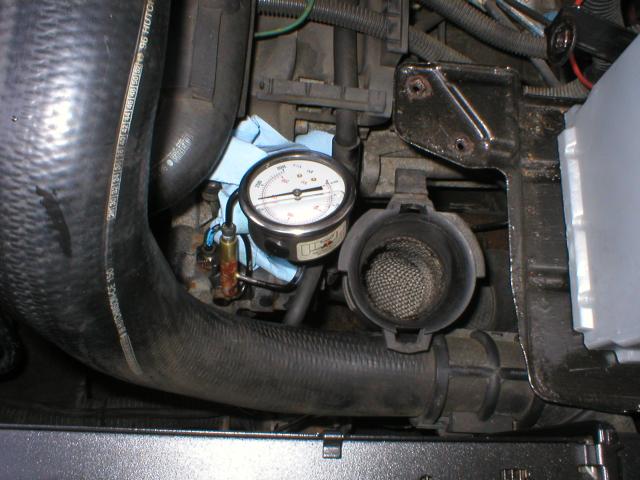
This is also excellent for measuring regulator cut-in and cut-out pressures as well as internal leakage problems; both of which can have profound effects on ride, especially if overall system pressure falls low enough for the anti-sink valves to operate.
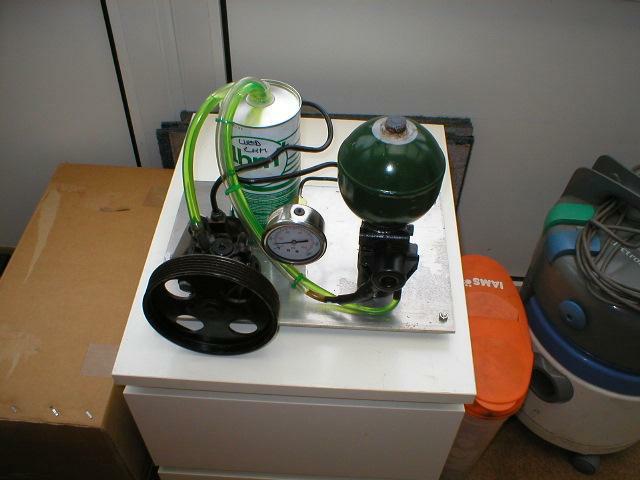
On balance, a sphere testing rig is not hard to make and very flexible in use too.. This, for those who have not seen it, is mine. Knocked up in an afternoon...
Ingenious but on some (and I'm thinking of the V6 and many XMs here ) you'd be hard-pressed to do it!The gauge I made up was a tee gauge to check dynamic pressure to look for any signs of internal leakage in an Activa but it would be easy to make a blanked-off one.
This is the gauge in use:
This is also excellent for measuring regulator cut-in and cut-out pressures as well as internal leakage problems; both of which can have profound effects on ride, especially if overall system pressure falls low enough for the anti-sink valves to operate.
On balance, a sphere testing rig is not hard to make and very flexible in use too.. This, for those who have not seen it, is mine. Knocked up in an afternoon...
Jim
A bit of a Citroen AX fan...
A bit of a Citroen AX fan...