

They have battery back back up on the Orkney system but theirs were in shipping containers so not quite as big.
Peter

Nice bit of oppurtunism from TESLA, not without a touch of irony, in that the company awarding them the contract are Southern Californian Edison, and Tesla are selling them a DC Battery!Peter.N. wrote:That's interesting Neil. The cost must be horrific, although probably not to someone with their sort of turnover.
Peter


 .
. Now while Tesla and Nissan can source Lithium-ion Batteries for their vehicles at prices to enable their cars to be profitable, the average DIY'er simply can't.I am selling my converted Berlingo Electrique. Details on eBay and batteryvehiclesociety.org.uk forum
Electric Berlingo van vehicle lithium battery 300 mile range | eBay
timpootle,Mar 11, 2015
Regards NeilOriginal E-Bay Listing http://www.ebay.co.uk/itm/Electric-Berl ... 675.l2557/
The bottom line-for a 1998 Berlingo Van! The lising is entitled...."“Scruffy 15 year old van with very big battery”
Costs new:
Cells £30,000
BMS £1,500
type 2 lead £70
van,motor,controller £800
IM axle £400
front battery box £70
sundries £400???
time £????
Asking for £29,000 all in, ONO

Yes, I did. I meant to comment at the time as I well remember a small fleet of them running around the site where I work for many years back along...Peter.N. wrote: Jim.
Did you see the picture of my old electric truck posted earlier on this thread?
Peter

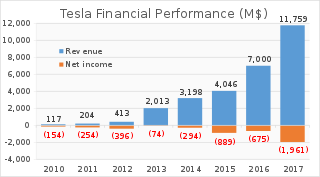
I think the main reason why net income is still negative (at least between 2014 - 2015 in the graph - I think things have improved since then) is because they are investing in building literally the biggest battery production facility in the world. When it is completed it will have more output capacity in lithium ion cells than the entire rest of the world production, which is quite staggering.NewcastleFalcon wrote: The world of really big business, involves lots of really big investment with no guarantee of future revenues. TESLA obviouslly aren't running a corner shop....it would have closed down by now after a few years of net losses.
Here's a nice little graph from wiki(Pheonix7777) (creative commons under this licencehttps://creativecommons.org/licenses/by-sa/4.0/deed.en )
The source, is the wonderfully detailed United States Securities and Exchange Commission Form 10-K ie Tesla's annual report and accounts.
Regards Neil.We are developing the Gigafactory as a facility where we work together with our suppliers to integrate battery material, cell, module and battery pack production in one location. We plan to use the battery packs manufactured at the Gigafactory for our vehicles and for our Tesla Energy applications. We broke ground on the Gigafactory in June 2014 and began assembling our Tesla Energy products in the first portion of the facility in the fourth quarter of 2015.
We currently expect to produce cells at the Gigafactory beginning in 2016 for use initially in our Tesla Energy products and later for our vehicles. The Gigafactory is currently expected to attain full production capacity in 2020, which is anticipated to be sufficient for the production of approximately 500,000 vehicles annually as well as for the production of our energy storage products. By that time, we expect battery pack production capacity to reach 50 GWh. Of this, we expect to build 35 GWh of cell production capacity at the Gigafactory and purchase 15 GWh of cells from other manufacturers.
We believe that the Gigafactory will allow us to achieve a significant reduction in the cost of our battery packs once we are in volume production with Model 3. The total capital expenditures associated with the Gigafactory through 2020 are expected to be $4 to $5 billion, of which approximately $2 billion is expected to come from Tesla. Panasonic has agreed to partner with us on the Gigafactory with investments in production equipment that it will use to manufacture and supply us with battery cells. We have a supply agreement with Panasonic that, among other things, allows us to purchase a minimum of 1.8 billion lithium-ion battery cells at preferential prices that we intend to purchase from 2014 through 2017. We have agreed to prepare and provide the land, buildings and utilities, invest in production equipment for battery module and pack production and be responsible for the overall management of the Gigafactory.
Ever wondered what the Gigafactory looks like?Mandrake wrote:
Of course if they have any excess production capacity it can be put into power walls and other battery contracts like Californian Edison - I can actually envisage a time in the next 10 years where Tesla makes more money from selling battery technology than actual cars - and I'm OK with that as long as they keep making great cars and pushing the boundaries there as well!
