
Hello, Just spotted this thread - that's really interesting about the metal fatigue. I'd never considered the forces that the metal dome experienced, thanks for your brilliant investigation!
By the way, it is possible to remove the damper valve from the sphere neck. You have to carefully machine off the rolled lip at the end of the sphere mounting thread. The damper then usually can be pulled out and it renders the sphere much like an accumulator in appearance. I have a couple of 500 cc spheres that were originally CX fronts (75bar) and with their pressure reduced down to 65bar and the damper removed, I have them waiting to be used as main accumulators at a future date.
Spheres and failure modes
-
aerodynamica
- (Donor 2025)
- Posts: 1690
- Joined: 26 Dec 2007, 18:10
- x 215
Re: Spheres and failure modes
Graeme M
2008 C5 Exclusive Tourer 2.0 HDi
2008 C5 Exclusive Tourer 2.0 HDi
-
white exec

- Posts: 7445
- Joined: 21 Dec 2015, 12:46
- x 1746

-
aerodynamica
- (Donor 2025)
- Posts: 1690
- Joined: 26 Dec 2007, 18:10
- x 215
Re: Spheres and failure modes
Hello Chris! I have not been lurking here for a while!
Graeme M
2008 C5 Exclusive Tourer 2.0 HDi
2008 C5 Exclusive Tourer 2.0 HDi
-
patje72
- Posts: 3
- Joined: 12 Nov 2017, 11:50
Re: Spheres and failure modes

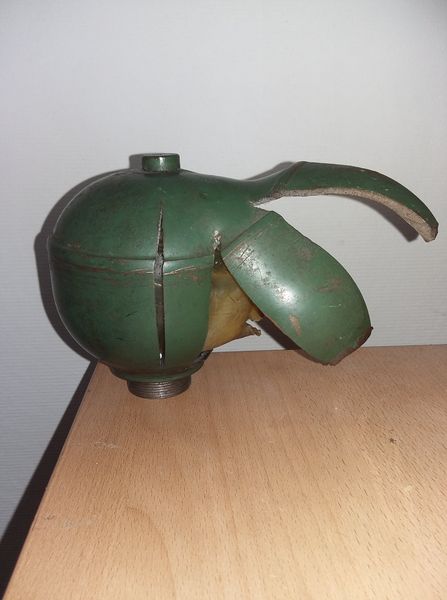
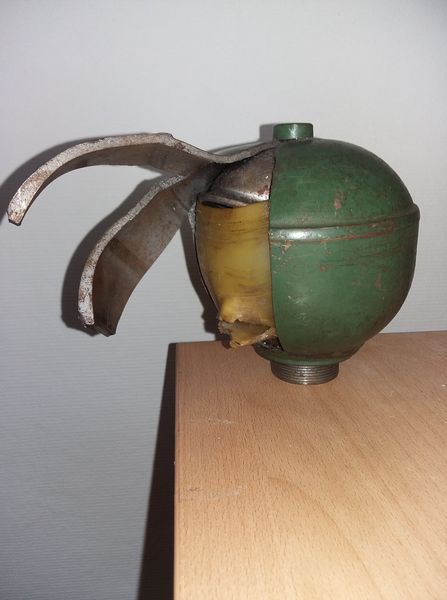
Another failure when the pressure regulator doesn't stop.......... (by the way this is a stocksphere)
-
GiveMeABreak

- (Donor 2016)
- Posts: 41989
- Joined: 15 Sep 2015, 19:38
- x 6945
Re: Spheres and failure modes
... and a reason why the later C5 / C6 saucer spheres have sharp metallic points inside to puncture the diaphragm if the pressure gets too great to prevent just this sort of thing.
Thanks for posting this
Thanks for posting this
Please note, I'm no longer active on the Forum, so won't respond to messages.
Marc
Marc
-
white exec
- Posts: 7445
- Joined: 21 Dec 2015, 12:46
- x 1746
Re: Spheres and failure modes
Truly alarming. Have never seen such a thing before.
Wonder if that sphere had had cold-chisel treatment (to loosen it) previously?
My guess is that the diaphragm would never reach saucer sphere spikes in a sphere with anything approaching normal gas pressure, however much system pressure was applied - and would, in any case, not prevent hydraulic pressure building up in the sphere. I think the spikes are there for other reasons.
Wonder if that sphere had had cold-chisel treatment (to loosen it) previously?
My guess is that the diaphragm would never reach saucer sphere spikes in a sphere with anything approaching normal gas pressure, however much system pressure was applied - and would, in any case, not prevent hydraulic pressure building up in the sphere. I think the spikes are there for other reasons.
Chris
-
GiveMeABreak
- (Donor 2016)
- Posts: 41989
- Joined: 15 Sep 2015, 19:38
- x 6945
Re: Spheres and failure modes
They are there so that in the event of bursting through overpressure, the pre-form prevents projections of metal pieces.
The pre-form can be seen at 'a'
Please note, I'm no longer active on the Forum, so won't respond to messages.
Marc
Marc
-
white exec
- Posts: 7445
- Joined: 21 Dec 2015, 12:46
- x 1746
Re: Spheres and failure modes
Still not sure how a ruptured (spiked) diaphragm would prevent metal casing splitting as a result of over-pressure, even if completely lined with plastic or another material.
Is there a history of split spheres? Why haven't we heard of this before?
Is there a history of split spheres? Why haven't we heard of this before?
Chris
-
GiveMeABreak
- (Donor 2016)
- Posts: 41989
- Joined: 15 Sep 2015, 19:38
- x 6945
Re: Spheres and failure modes
Faulty Regulator, even mentioned on Club XM:
http://www.club-xm.co.uk/forum/viewtopi ... 993#p30626
Others have mentioned different thickness of metals of some spheres
https://www.planete-citroen.com/forum/s ... E9clat%E9e
But from what I can see, can also be down to 'DIY' issues....
http://www.club-xm.co.uk/forum/viewtopi ... 993#p30626
Others have mentioned different thickness of metals of some spheres
https://www.planete-citroen.com/forum/s ... E9clat%E9e
But from what I can see, can also be down to 'DIY' issues....
Please note, I'm no longer active on the Forum, so won't respond to messages.
Marc
Marc
-
white exec
- Posts: 7445
- Joined: 21 Dec 2015, 12:46
- x 1746
Re: Spheres and failure modes
Interesting that both those threads are dated about 10 years ago.
Nothing heard of this (sfaik) in recent years.
The photo on planete does seem to show a sphere with thinner walls, although difficult to tell from the angle.
I presume the sphere halves are castings, which are then welded together.
A pukka Citroen sphere here, which I cut in half a few years ago, has a wall thickness of 3.5mm (minimum) over most of its area, and 5-6mm near the neck/base.
If Citroen became aware that any of its own spheres could explode, my guess is that they would have done something about it - which is maybe why there don't seem to have been recent reports.
It's always possible that there may have been one or more faulty batches, either Citroen's or someone else's.
_______
Wondered how much pressure in total was exerted on a sphere's walls.
Quick bit of maths gives
Surface area of a 90mm diameter sphere is 25457mm² (40 in²)
Pressure = say 175bar, which with a quick change of units to get a feel for it, = 2572 lb/in²
So total outward force = 2573 x 40 = 102,880 lb
= 46 tons.
And there's a hole at the top, threaded and plugged.
We know from aircraft windows that piercings are weak points...
My maths might be out, of course.
Nothing heard of this (sfaik) in recent years.
The photo on planete does seem to show a sphere with thinner walls, although difficult to tell from the angle.
I presume the sphere halves are castings, which are then welded together.
A pukka Citroen sphere here, which I cut in half a few years ago, has a wall thickness of 3.5mm (minimum) over most of its area, and 5-6mm near the neck/base.
If Citroen became aware that any of its own spheres could explode, my guess is that they would have done something about it - which is maybe why there don't seem to have been recent reports.
It's always possible that there may have been one or more faulty batches, either Citroen's or someone else's.
_______
Wondered how much pressure in total was exerted on a sphere's walls.
Quick bit of maths gives
Surface area of a 90mm diameter sphere is 25457mm² (40 in²)
Pressure = say 175bar, which with a quick change of units to get a feel for it, = 2572 lb/in²
So total outward force = 2573 x 40 = 102,880 lb
= 46 tons.
And there's a hole at the top, threaded and plugged.
We know from aircraft windows that piercings are weak points...
My maths might be out, of course.
Chris
-
white exec
- Posts: 7445
- Joined: 21 Dec 2015, 12:46
- x 1746
Re: Spheres and failure modes
- Citroen "Acc" sphere
Wonder whether Accumulator spheres, which have to deal with the full 175bar pumped system pressure, are something special?
Spheres in other locations are typically 70 or so bar max, plus loading/impacts, without continuous exposure to this high system pressure.
Have put a few old (Citroen) spheres on the scales this morning, but nothing significantly different shows up:
eg BX RR corner - 1632g
Acc, empty, with a Valprex (and no damper, obviously) - 1596g, and another at 1574g (no Valprex)
Other standard spheres came in at 1582, 1540, 1562g (none with a Valprex)
So, no obvious indication that additional steel is involved.
Easy for owners (or suppliers) to make use of other damperless spheres (eg Hydractive centre ones) for Acc purposes; have done this myself more than once, simply by re-gassing to 62bar.
Chris
-
thorter
- Posts: 225
- Joined: 22 Feb 2005, 02:07
- x 44
Re: Spheres and failure modes
I no longer have a Xantia, but think is that these spheres start manufacture as a drawn cup, the plastic bag is fitted, then the cup is closed down on to the threaded end piece. This will need a fairly large press and tooling. The plastic bag would probably be partially evacuated to be out of the way, then the end piece and main part welded.
My impression is that accumulator spheres are no different from suspension spheres, and indeed, when the suspension is set to high, everything is filled with 175 bar pressure. I have certainly converted 500 ml spheres to accumulators without any sign of a problem. Incidentally, I suspect that when subjected to high, this is when the filling bolt can puncture a sphere that is low in pressure. If you have the means, keep the pressure topped up.
Perhaps the burst sphere had been cold chiselled off (though no obvious marks), but more likely in this case, the weld was faulty and it tore away there.
T
My impression is that accumulator spheres are no different from suspension spheres, and indeed, when the suspension is set to high, everything is filled with 175 bar pressure. I have certainly converted 500 ml spheres to accumulators without any sign of a problem. Incidentally, I suspect that when subjected to high, this is when the filling bolt can puncture a sphere that is low in pressure. If you have the means, keep the pressure topped up.
Perhaps the burst sphere had been cold chiselled off (though no obvious marks), but more likely in this case, the weld was faulty and it tore away there.
T
-
white exec
- Posts: 7445
- Joined: 21 Dec 2015, 12:46
- x 1746
Re: Spheres and failure modes
Interesting, and you're right: when set to High, all the spheres are at system pressure.
Looking again at the photos above, it does look as if the base weld has given way, which would then allow the sides to 'peel away'. Some years back there were comments on Club-XM about the base weld on some spheres being of varying smoothness (quality?), causing difficulty in screwing spheres down completely, metal-to-metal, on to the machined surfaces.
Looking again at the photos above, it does look as if the base weld has given way, which would then allow the sides to 'peel away'. Some years back there were comments on Club-XM about the base weld on some spheres being of varying smoothness (quality?), causing difficulty in screwing spheres down completely, metal-to-metal, on to the machined surfaces.
Chris
-
thorter
- Posts: 225
- Joined: 22 Feb 2005, 02:07
- x 44
Re: Spheres and failure modes
It certainly does look as if it has failed round the base. It is interesting how straight the failure tears are, but that might be a result of the manufacturing process which presumably consists of serious cold forming.
The weld would probably still be the weakest point, as it would be difficult to get full penetration working only from one side.
T
The weld would probably still be the weakest point, as it would be difficult to get full penetration working only from one side.
T
-
white exec
- Posts: 7445
- Joined: 21 Dec 2015, 12:46
- x 1746
Re: Spheres and failure modes
Have just noticed that the weld at the base, and the way the shell joins the base-plug (threaded part/damper insert), looks completely non-standard, and nothing like Citroen's own spheres.
The squared-off (turned) shell edge is clearly visible and free from weld.
Will try to post a comparison photo tomorrow.
The squared-off (turned) shell edge is clearly visible and free from weld.
Will try to post a comparison photo tomorrow.
Chris