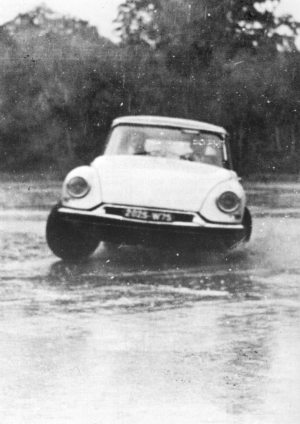
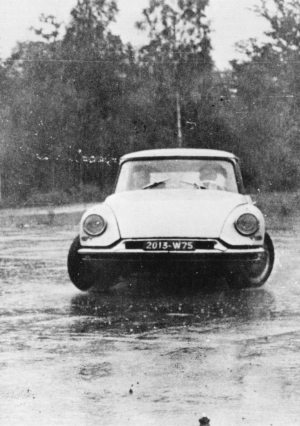
Prompted by the thread 'Citroen Activa I & II Prototype Videos' (http://www.frenchcarforum.co.uk/forum/v ... =3&t=41072) where some really good suspension looks to be in action, double wishbones included, I was set wondering just what the system employed in the no roll DS was. According to Citroenet it was ready for production in the mid-sixties and had been intended to be an integral part of the hydraulic suspension design - Magès had developed a variant of his original ideas to demonstrate it on a 2cv as early as 1946.
Does anyone know more about this or are there any remains of the system lurking at the Conservatoire?
PeterN: "Honest John's forum put the last nail in the coffin of owning a 2000- car. Many were still servicable, but CR, DMFs and needing fault codes read because your horn doesn't work - no thanks. All my life I have generally understood cars - until now."
I believe that one used a pendulum to detect roll; the pendulum controlling a roll corrector valve in almost exactly the same way as the Activa works. Most of the Activa roll control is hydro-mechanical, the only electronic bits are used to control suspension stiffness in the normal Hydractive way and Anti-Roll Bar stiffness using a sphere and electrovalve as a spring that effectively reduces the diameter of the very stiff roll bars it has...
Shame they never produced it on the DS and SM...
Likewise the hydraulic drive they also developed and never produced. Basically, with that the engine would have driven a big pump and everything else would have been operated hydraulically. I have a belief the big problem was the hydraulic transmission was rather noisy...
Fantastic - hydraulic or hydrostatic transmission with an accumulator or two to store power on the overrun, when braking and when stopped with the engine running - to be used for extra power when accelerating = more performance, more economy. Bosch have got some test vehicles with just this type of setup at the moment, it's proving more efficient than electric 'hybrid' vehicles (now there's a surprise!).
Powered windows, central locking, windcreen wipers, starter motor, alternator, radiator fan, air brakes... it makes you wonder if they experimented with hydraulically powered lighting. More seriously, hydraulic motors are both light and long lasting, if relatively expensive (reducing with economies of scale) and noisy - although I believe the noise has been engineered out of their design in recent years. I've a couple of cars with manual back-ups for the then new-fangled, untrustworthy electric motors which ran the wipers. To think we (collectively, as Man - not as intelligent fcf contributors) use overweight electric motors to move ourselves backwards and forwards within the car - now that really is crazy!
PeterN: "Honest John's forum put the last nail in the coffin of owning a 2000- car. Many were still servicable, but CR, DMFs and needing fault codes read because your horn doesn't work - no thanks. All my life I have generally understood cars - until now."