
Below, two very different cars' front suspensions - one (1974 CX) with a minimally-sized antiroll bar, the other (1983 Pug-derived BX) a bit bigger.
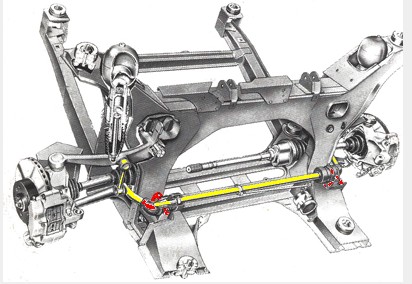
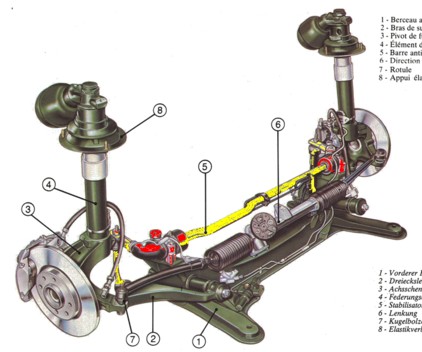
From a suspension engineer's perpective, the much-used anti-roll bar is a huge compromise - an admission that mass centres are too high, tracks too narrow and roll couples too big. It allows cheaper suspension to work acceptably well and for softer springing. But it is as cheap a major suspension component as there is - one main reason for its proliferation - and with well-designed positioning, not too thick a bar and careful tuning into the spring and damper settings they can work reasonably well.
With a suspension with adjustable-length pushrods, it is quite possible to create a well-engineered system which counters roll to a greater or lesser degree. Citroen themselves had one up and running in the sixties, http://www.citroenet.org.uk/miscellaneo ... ics-2.html which was part of Mages' original design for fluid suspension, so minimising or avoiding altogether the need for antiroll bars. Although the Xantia Activa used a very simplistic system to reduce roll by twisting up the torsion bar with rams - instead of altering the length of incompressible liquid pushrods which would have been the elegant solution as well as Citroen's original. This cheap approach is the one used by Range Rover and BMW which are trying to improve their ride and stability - however Mercedes has ditched the antiroll bar completely and used the variable liquid pushrod approach with its ABC suspension on top models. In the past it has used Citroen's patents for its estate cars' rear suspension.
Tenneco's Kinetic suspension (below right) as used by F1 and Citroen's rally C4 also does away with antiroll bars - http://www.autozine.org/technical_schoo ... nsion3.htm but requires electronics and all the wiring and sensors which go with it. Citroen's own (original) technology was as simple and clever as the its old-fashioned hydraulic valves to control fluid flow.
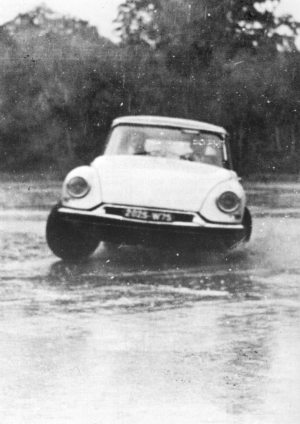
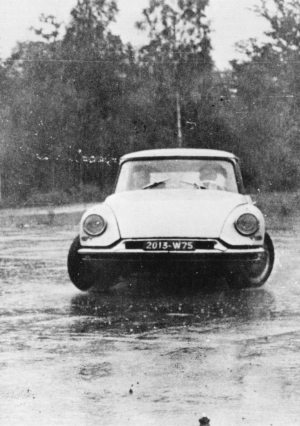
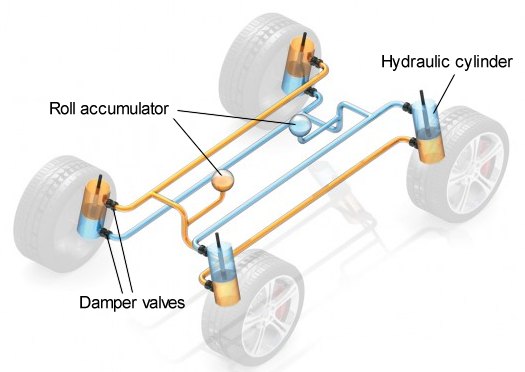
 So, if Mercedes rejects the Xantia Activa approach and throws away the antiroll bars along with the best Formula 1 cars, perhaps they're not a good thing at all. We all know that an antiroll bar appears to improve the cornering of a car and that it doubles as a place to position the ride height correctors on hydraulic Citroens, but what are the downsides to this bit of suspension?
 It is a very crude piece of suspension - an undamped spring (torsion bar), which seems in complete contrast to the fineries of a Citroen's underpinnings. For many years the 'big thing' was 'independent suspension' - ie wheels able to move independently of each other, unlike those linked with a solid axle as on a 4x4. Linking left and right wheels with a torsion bar destroys some of the benefits of this independence.
Since such proven and quality cars as Saab's 99 and 900 (developed from many years' rallying success) did without them completely in most of their variations, are they completely necessary - or desirable? Many cars today use the cheap-to-make MacPherson strut with its less-than-perfect geometries and which works best without body heel - which happily coincides with public demand for cars which corner flat.
Provided both left and right wheels rise and fall at the same time, there is no problem - the bar moves up and down with them and provides no resistance to travel. But few roads are like this and even though soft rubber bushes can absorb some very small amplitude irregularities, anything much more than a couple of centimetres will have one side of the car affecting the other.

This is felt in the cabin as the now universal rock-roll, which is accepted and even ignored by drivers and passengers even though the lateral forces on their necks can be considerable. Follow a modern car down a less-than-perfect road and watch the highly-visible effects for yourself. It will highlight either the discomfort of this effect as it happens to you, or make your well-suspended machine seem even better as you pass over the same bit of road without any rapid, uneasy motion. It is most evident where the left side of a road has repeated sink-holes or sunken grids.
As most cars are engineered by the French or Germans for smooth, level roads, our lumpy British ones can highlight this effect. The discomfort is nothing to the destabilising effect this has on the car at higher speeds, as wheels are jolted rapidly in one direction then the other, the roadspring's damper and tyre trying to damp out the torsion bar's springing oscillations.
If irregularites are on just one side of the road, the effect is limited to the opposite wheel. If they occur on both sides but not at the identical time, both wheels are being forced one way then the other, as well as actually coping with what is happening with the road at their own side. It is testimony to modern tyres and damping that the effects are not worse than they are. Not only is the grip reduced on an imperfect road, but steering is affected also, as would be expected with such violent forces acting on the front suspension.
 Lots of Loading
A strong crosswind can cause you to have to turn into it on an exposed road, which unloads the 'inside' or weather-side tyre. With a heavy car travelling at lower speeds this may have no effect, but go faster in a lighter car and the last thing you wish for in a strong crosswind is uneven grip on the front wheels. Combine that with the front drive car's use of a rubber-bushed self-steering rear axle and the effect can be quite surprising. A sudden high gust will force you to turn into it if you want to maintain your course, which makes the car's cheap bits think you're cornering.
Even the heavy Xantia felt very shifty in a stiff and gusty crosswind last winter, so out of interest I took a CX onto the same patch of motorway and drove it at the same speed I had in the Xantia. The noisier A posts and door sealing of the CX only served to enhance the contrast. I took it to the same speed at which I'd originally slowed from and no difference. Even at an additional 20mph the old car tracked straight and true, barely affected by the breeze. What had been a tiring journey in the other car would have been a pleasure in the CX, apart from the dodging of nervously-crawling BMWs and weaving HGVs.


As you corner, these forces can do nothing to help the tyre's grip with the road - they reduce it. Additionally, an antiroll bar reduces the grip on the inside tyre while loading up the outside - that's one of the immutable 'no such thing as something for nothing' laws. The only way round this is to fit wider tyres, which in turn fits in well with the workings of the MacPherson strut. All very well on a smooth and level grippy surface, but it makes the differential between good and poor road condition (ie surface, foundations, grip etc) abilities significantly greater. One thing which is very noticeable in a CX is just how much people slow when conditions deteriorate - and how that particular car's abilities continue to work at very nearly the same high level.

Of course, most cars are more comfortable than ever before in the eyes of their owners. Often this is the case, especially if you compare Fords from the 1980s with a 21st century one. But imagine just how good a modern car could be with low mass centre/low roll couple and independent suspension.