Voltage Test Results at N/s relay pins, with relay plugged in, engine running:
AC On (volts)
--------
T1 - 14.3
T2 - 14.3
T3 - 14.3
T5 - 14.3
AC off
--------
T1 - 0.7
T2 - 0.2
T3 - 14.3
T5 - 2.0
All in all it looks good now, having cleaned up the earth (t5) in central relay.
However, just one fan comes fully on with temp sensor removed, and stays running fast
With AC switched on, i get no fans ( temp sensor in place).
Seems to me fault may be,
1. Fan brushes
2. Mirror temp sensor
3. Coolant temp sensor
4. Pressure of AC drier
5. A combination of any of the above
The coolant temperature sensor seems to be OK. From Admiral's howto, I gather the fans should run on slow with AC on, even if the AC pressure is low.
Q. Can I rule out any of the possible faults 1-5 given above?
Q. Am I on the wrong track?
Q. What other useful tests could I do at the central relay?
Thank you for your kind help, and the information in other posts.
John
Sent from a mobile transmitter.
John Plum
Xantia II Estate,1999, 2.0 HDI LX, 17000 miles, manual
Well, that's kind - I did write it hoping it would also serve someone as good reference.
Update: I may have to change the fan, as it won't restart without a tap. I did try running The fans on fast for a good period, hoping they might 'clean up' their act.
Perhaps there's a special knack to tapping, so as to free a seized/clogged brush?
John.
Sent from a mobile transmitter.
John Plum
Xantia II Estate,1999, 2.0 HDI LX, 17000 miles, manual
Nah!
I'd say one of the brushes has reached the bottom and needs to be replaced.
Never had one of those apart and wouldn't be surprised to hear it's sealed.
If you CAN open it, then any good auto-electrician should be able to supply brushes that can be made fit.
Mine keeps an oddment bucket of brushes and holders, salvaged during reconditioning work and I've got suitable replacements for many small motors from there. Small alternator brushes often almost fit drills and wiper motors, for example. One that's slightly big is easily filed down to fit and will probably be free, too!
Fan motors have to work much harder nowadays, with Air Con requiring them to run constantly, yet they're not built anything like as robustly as older types that only had a small duty cycle. They do wear out and need replacing. If the brushes are worn down, as I suspect, you may find the bearings are shot too! Good brushes in a seized motor effectively create a short circuit, so a certain amount of care/ common sense is vital when deciding whether to repair or replace!
Yeah, I assumed it was sealed - haven't hear about them being serviceable on the forum on any post I've read . If they are, I'd replace the brushes. From my cursory view, it looks like it can't be dismantled in situ.
Your hunch about shot bearings may well be right, I noticed it appears to wobble very slightly, certainly compared to its mate alongside. In the past I've replaced bearings in good old units. BUT:
Not expecting the quality of housing of the old units, I thought replace it with a fan from my old car - they seem good.
I haven't removed one before from a Xantia, I expect it's straight forward, but may have to remove the front engine bay cross member thing (crash bar?)
Interesting point about the short circuiting brushes in a seized motor.
John
Sent from a mobile transmitter.
John Plum
Xantia II Estate,1999, 2.0 HDI LX, 17000 miles, manual
Yes
Only common sense, though, when you think about it.
An armature winding is just a piece of wire, albeit a long one.
If the motor doesn't turn, that piece of wire stays in contact with the positive and the negative, via the brushes.
The current limiting factor, in this situation, will be the cross sectional area of the armature wire, or the fuse, whichever is the lower! Except on certain French cars, where the loom went first, with spectacular results.
When the motor is working, the movement of the coil through the magnetic field generates a "back emf" that opposes the normal flow and also the arrival of a new pair of commutator segments and departure of the present ones limits the time the current can flow in any given coil.
If you have access to an oscilloscope you can actually see this in action. The current required to start a motor from rest is massively more than is needed to keep it running, even under load! You can see the voltage drop and current spike at startup and quickly recover as the motor gets going.
Inductors (coils!) are fascinating things, if you're into analogue...
The working of a coil motor is brilliant when you start to appreciate it. I remember when we made a simple one in physics o-level. Well they are simple but the appreciation of why it works is amazing. That trial invited the sort of discussion you're talking.
The fact that it turns and keeps turning, and that the resultant changing electromagnetic forces suit it turning, is pretty darned convenient, like it was meant to be , a discovery, not invention.
Considering the effect of electric motors upon industry, maybe it's as big a landmark as the Hoffman steam engine
Q. Anyway, do I have to remove the bumper to get at the fans?
Sent from a mobile transmitter.
John Plum
Xantia II Estate,1999, 2.0 HDI LX, 17000 miles, manual
John Plum wrote:Q. Anyway, do I have to remove the bumper to get at the fans?
Sent from a mobile transmitter.
Hi John
I'm afraid I'm no use to you on that one. Mine has no air conditioning and only a single fan, which is working at the moment.
This being the first Xantia I've ever touched, I can't say whether it'll be tough to extract them or not.
Watching with interest...
Update on repair:
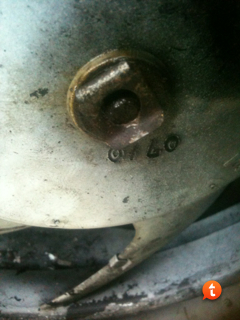
I began the job to remove a fan blade and motor from my old car. However, on my 2000 Xantia the fan blade, unlike my present 1999 xantia and in the topic (35076) above, isn't held in with a screw, but with a clip as in the picture below.
The blade doesn't pull away easily at all, possibly because this method permits water ingress. It may also be a tighter interference fit.
I removed the blade from the faulty fan motor on my present car, retained with a screw. It pulled off easily.
With the motor body exposed, I was able to give it a good direct tapping all round with a copper mallet. That fixed it. It now restarts fine!
That'll do for now.
Sent from a mobile transmitter.
John Plum
Xantia II Estate,1999, 2.0 HDI LX, 17000 miles, manual